
7 Signs of a Bad Ignition Switch: Don't Get Stranded in Austin

Imagine sitting in your car on a scorching afternoon in Austin, turning the key, and hearing absolutely nothing. You might assume your battery is dead, but for many drivers, the culprit is actually a failing ignition system. It's a stressful moment, especially since approximately one-third of drivers cannot cover a surprise $500 repair without going into debt as of May 2026. You're likely worried about the high cost of a dealership visit or the nightmare of being stranded in the Texas heat.
Recognizing the early signs of a bad ignition switch is the best way to protect your wallet and your schedule. This guide will teach you how to spot these symptoms before they leave you stuck on the side of the road. You'll learn how to differentiate between starter issues and ignition failure. We'll also explain how our rapid, mobile experts provide on-site ignition repair for between $150 and $500, often beating the $311 average dealership cost. We're moving quickly from diagnosis to a reliable, local solution that brings the shop directly to your driveway.
Key Takeaways
- Learn to spot the primary signs of a bad ignition switch before your car leaves you stranded in the Austin heat.
- Use the simple "Headlight Test" to quickly determine if your vehicle's issue is a dead battery or an internal electrical failure.
- Discover why 100-degree Texas summers cause ignition components to fail and how to catch these problems early.
- Avoid high dealership costs and towing fees by opting for rapid, on-site ignition repair that comes directly to your location.
- Understand the difference between mechanical lock issues and electrical switch failures to ensure you get the right fix the first time.
What is an Ignition Switch and Why Does It Fail?
Your vehicle relies on a complex network of wires and signals to roar to life. At the center of this network sits the ignition switch. It's the electrical gateway that powers your engine and accessories. Many drivers confuse the mechanical lock cylinder, where you slide your key, with the actual electrical switch. While the cylinder provides security, the switch behind it handles the heavy lifting of power distribution. To understand What is an Ignition Switch, you must view it as the primary bridge between the battery and the starter motor.
This component is the most overworked electrical part in your car. Think about your daily commute or a quick trip to Zilker Park. Every time you stop and start your engine, you're putting this switch to work. Over years of driving, these cycles add up. If you start noticing the early signs of a bad ignition switch, it's usually because the internal copper terminals are wearing thin or becoming clogged with debris. We see this often in our mobile service calls. A switch that worked yesterday can suddenly fail today, leaving you stranded in a parking lot. It acts as the central brain for power distribution, so when it fails, your entire vehicle's electrical system can become unpredictable.
The Four Key Positions of Your Ignition
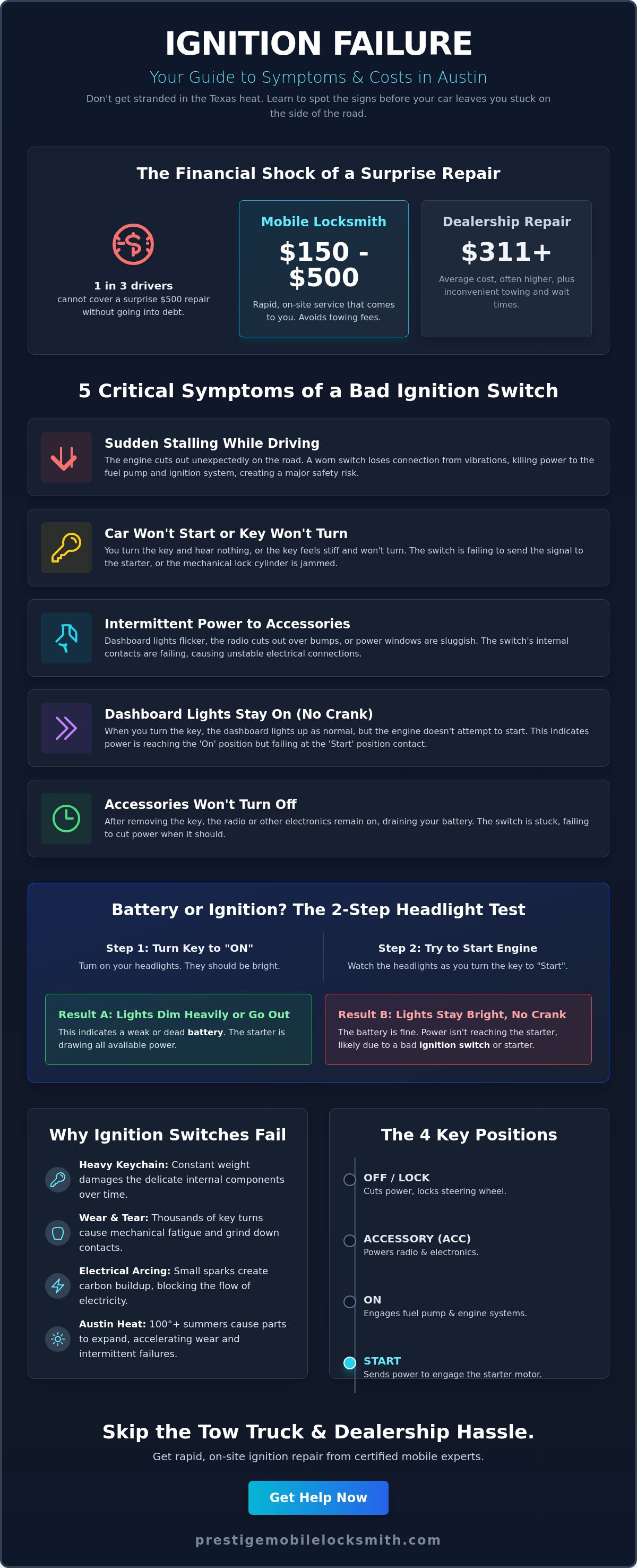
Your ignition switch operates in four distinct stages to manage your car's power. In the Off position, it secures the steering wheel and cuts all non-essential power. The Accessory (ACC) stage powers the radio and lights without draining the battery for start-up. Moving to the On position engages the fuel pump and engine management systems. Finally, the Start position creates a momentary high-draw connection that engages the starter motor. If the switch fails at any of these points, you'll experience different signs of a bad ignition switch, from a silent engine to a radio that won't turn off.
Common Reasons for Ignition Switch Wear
Why do these switches fail? Mechanical fatigue is the most common culprit. Thousands of turns over the vehicle's life eventually grind down the internal components. Your heavy keychain is another hidden enemy. The weight of dozens of keys pulls on the cylinder, which damages the delicate electrical contacts inside the switch. Additionally, electrical arcing can occur. This creates carbon buildup on the copper terminals, preventing a clean flow of electricity. Our certified technicians often find that heat expansion in Austin, especially during the 100 degree summers of 2026, accelerates this process. This causes intermittent contact failure in older housings. When this happens, you need a rapid, on-site solution to get back on the road without a tow truck.
5 Critical Symptoms of a Bad Ignition Switch
Driving on I-35 or MoPac requires your full attention. The last thing you need is your engine dying at 65 mph. Sudden stalling is one of the most dangerous signs of a bad ignition switch. Road vibrations can cause a worn internal contact to lose its connection. When this happens, the power to your ignition system and fuel pump cuts out instantly. You'll lose power steering and braking assist, making the car difficult to control. Many drivers mistake this for a failing fuel pump. However, if your dashboard lights go dark at the same time, the switch is likely the culprit.
Another common headache is an engine that refuses to crank. You turn the key, but nothing happens. If your battery is healthy, the problem often lies in the "Start" position of the switch. It fails to send the necessary signal to the starter motor. To help narrow it down, you can ask yourself: Is It the Battery, Starter, or Ignition Switch? Professional diagnosis prevents you from spending money on a battery you don't need. This is vital since the average car repair now costs $838 as of May 2026.
Intermittent power loss is another red flag. You might notice specific electronics acting up while the engine is running. These symptoms include:
- Dashboard lights flickering or going dark temporarily.
- The radio cutting out when you hit a bump.
- Power windows or wipers operating slowly or not at all.
- The interior lights dimming unexpectedly.
Sudden Stalling and Engine Cut-Outs
When an ignition switch fails mid-drive, the results are immediate. The electrical bridge we discussed earlier collapses. Your engine management system loses power, and the vehicle shuts down. This creates a high-stakes safety risk on busy Austin streets. If your key feels "mushy" or doesn't click firmly into place, the mechanical components are likely failing. This physical wear prevents the electrical terminals from staying locked together during transit. Catching these signs of a bad ignition switch early can prevent a dangerous highway emergency.
Anti-Theft System and Immobilizer Issues
Modern vehicles use sophisticated security handshakes. Your ignition switch must communicate with the transponder chip in your key to allow the engine to run. A faulty switch breaks this communication. You might see the "Security" or "Anti-Theft" light stay on even after you try to start the car. Sometimes the engine will fire up but die after exactly two seconds. This is a classic immobilizer lockout. Because these systems are complex, you'll need a certified automotive car locksmith to reset the system and program the new switch. If you're seeing these symptoms, we can perform a rapid ignition repair at your home or office to get you back on the road fast.
Is It the Battery, Starter, or Ignition Switch?
When your car refuses to start, the "Big Three" suspects are your battery, starter, and ignition switch. Systematically eliminating these prevents you from wasting money on parts that still work. A simple "Headlight Test" is your first step. Turn your headlights on and try to crank the engine. If the lights go dark, your battery lacks the power to turn the motor. If the lights stay bright but you hear nothing, you're likely seeing the primary signs of a bad ignition switch. This distinction saves you from an unnecessary tow to a dealership.
Sound is your next diagnostic tool. A rapid clicking noise often points to a dead battery or a failing starter solenoid. A single loud "clunk" usually means the starter motor is physically jammed. Total silence, however, points directly to the ignition switch. It means the electrical signal never left the steering column. Understanding the locksmith cost Austin residents pay for a mobile service call, which typically ranges from $29 to $100 as of May 2026, is much cheaper than guessing with expensive parts. Prices for motor vehicle repair are 197.57% higher in 2026 than in 1997, so an accurate diagnosis is vital for your budget.
The Dashboard Light Diagnostic
Watch your instrument cluster carefully. When you move the key to the "On" position, the dashboard should light up. If it stays dark, the switch has failed to bridge the gap between the battery and the rest of the car. Sometimes you'll find the car starts fine, but you have no power in "Accessory" mode. This partial failure is one of the subtle signs of a bad ignition switch that many drivers ignore until they are stranded. Neglecting these symptoms can lead to the dangers of a faulty ignition switch, which has historically caused serious road accidents and injuries.
Starter vs. Switch: The Sound of Failure
Differentiating between a starter and a switch requires a logical approach. A starter failure is often loud and physical. A switch failure is quiet and electrical. If you have a multimeter, you can check for 12-volt power at the starter solenoid while someone turns the key. No power there means the switch is dead. The ignition switch is the most overlooked part of the starting circuit. Many people replace their starter only to find the car still won't turn over. We help you avoid this "parts cannon" approach with a rapid, accurate diagnosis at your location. This is essential since approximately one-third of drivers cannot cover a surprise $500 repair without going into debt this year.
Why Austin Drivers Face Unique Ignition Challenges
Austin's climate plays a massive role in your vehicle's reliability. While generic guides mention general wear and tear, they often ignore the brutal impact of 100°F+ Central Texas summers. High temperatures cause the plastic and metal components inside your steering column to expand at different rates. This expansion often leads to intermittent contact failure, especially in older ignition housings. You might find your car starts perfectly in the cool morning but refuses to turn over after sitting in a sun-drenched parking lot near Zilker Park all afternoon. These are classic signs of a bad ignition switch influenced by our local environment.
Beyond the heat, dust and limestone debris from Austin's constant construction infiltrate the lock cylinder. This grit acts like sandpaper. It grinds down the internal pins every time you insert your key. Attempting a DIY repair in this high-heat, high-stress environment is risky. Without specialized tools, you might accidentally trigger the airbag or damage the delicate clock spring. This leads to even more expensive repairs that far exceed the cost of professional help. We bring the tools and the shade to you, ensuring the job is done right the first time.
Heat-Induced Electrical Resistance
Extreme heat doesn't just expand parts; it degrades the specialized grease inside the ignition lock cylinder. This grease is designed to keep mechanical movements smooth. When it thins out or dries up due to triple-digit temperatures, the mechanical action becomes stiff. This resistance puts extra strain on the electrical switch sitting behind the cylinder. If your key feels unusually hot to the touch when you remove it, take notice. Internal electrical arcing is likely generating that heat, which is one of the physical signs of a bad ignition switch you should never ignore.
The Heavy Keychain Problem
Austin's active lifestyle often leads to bulky key rings filled with house keys, gym tags, and heavy carabiners. Gravity is not your friend in this scenario. Every road bump on MoPac or I-35 turns that heavy keychain into a lever. It slowly pries the internal components of the switch apart. Over time, this weight destroys the alignment of the electrical terminals, leading to a "mushy" feel when you turn the key. Our experts recommend keeping your car key on a separate, lightweight ring to protect your ignition system from unnecessary mechanical stress.
If your key is already sticking or your dashboard is flickering, don't wait for the next heatwave to leave you stranded. Contact us for professional ignition repair and get a reliable solution delivered to your doorstep today.
Professional Ignition Repair: Why Call a Mobile Locksmith?
Choosing between a dealership and a mobile locksmith is often the difference between a minor inconvenience and a week-long headache. Dealerships frequently require you to pay for a tow truck just to get your vehicle onto their lot. Once there, you might face a multi-day wait before a technician is even available. We eliminate the "Dealership Trap" by bringing the entire shop to your driveway. If you've identified the signs of a bad ignition switch, you need a solution that respects your time and your budget. Our rapid response team handles everything from the initial diagnosis to the final transponder programming on-site.
Safety is our top priority during every repair. Modern steering columns house delicate components like airbags and clock springs. One wrong move during a DIY attempt can trigger a costly safety system failure or even physical injury. Our certified experts possess the training to navigate these high-tech systems safely. If your key is physically stuck or won't turn at all, we also provide an emergency lockout service Austin drivers can rely on 24/7. This comprehensive approach ensures your car is secured and functional without the need for multiple service appointments.
On-Site Diagnosis and Replacement
Precision matters when dealing with your vehicle's security. Our technicians typically diagnose ignition issues in under 30 minutes. We use specialized tools to remove the faulty switch without damaging the surrounding lock cylinder. This level of care is essential for maintaining your car's integrity. Once the new hardware is installed, we program it to work perfectly with your existing keys. You won't need to carry two different sets of keys or worry about transponder handshake errors. We ensure every electrical connection is solid and every security protocol is met before we leave.
The Cost-Benefit of Mobile Service
The financial math favors mobile service every time. While dealerships charge premium labor rates, mobile locksmiths in Austin offer ignition repair for between $150 and $500 as of May 2026. You also avoid the added expense of a tow, which can easily cost another $100. Our service call fees remain transparent, typically ranging from $29 to $100 depending on your location. This is a critical advantage since prices for motor vehicle repair have risen 197.57% since 1997. We provide 24/7 availability for night-shift workers and commuters who can't wait for a shop to open at 9 AM. Contact Prestige Mobile Locksmith for rapid ignition repair in Austin and let us bring the solution directly to you.
Get Back on the Austin Roads Today
Recognizing the signs of a bad ignition switch early is the key to avoiding a high-stakes roadside emergency. You now know how to distinguish between a simple battery jump and a complex electrical failure. You also understand why Austin's triple-digit heat makes your vehicle's ignition system more vulnerable than in other regions. Don't let a failing switch turn into an expensive dealership ordeal involving towing fees and long wait times.
Our licensed and insured Austin technicians are ready to bring the solution to your doorstep. We maintain a 30-minute average response time to ensure you aren't left waiting in the heat. With advanced ECU and transponder programming tools, we handle even the most modern security systems right on-site. We take pride in being your neighborly experts who prioritize your safety and your schedule. We're proactive problem-solvers dedicated to getting you moving again.
Call Prestige Mobile Locksmith now for 24/7 mobile ignition repair in Austin! You deserve a reliable fix that gets you back to your life without the stress of a traditional shop.
Frequently Asked Questions
Can a bad ignition switch cause my car to lose power while driving?
Yes, a faulty switch can cause your engine to shut off instantly while you are in motion. This happens when worn internal contacts lose their connection due to road vibrations or heat expansion. It is a dangerous situation that often occurs on high speed Austin roads like MoPac. You will lose power steering and braking assist, so pull over safely as soon as you feel the engine sputter.
Will a bad ignition switch drain my battery overnight?
A failing switch can definitely drain your battery if it gets stuck in the "Accessory" or "On" position. Even if you remove the key, the internal terminals might stay connected. This keeps your car's computer and electrical relays active. If you notice your radio stays on or your dashboard remains lit after you leave the vehicle, these are clear signs of a bad ignition switch that requires immediate attention.
How much does it typically cost to replace an ignition switch in Austin?
Mobile locksmiths in Austin currently advertise ignition repair services ranging from $150 to $500 as of May 2026. This price varies based on your vehicle's specific make and model. Choosing a mobile service helps you avoid the average $100 towing fee required to reach a dealership. We provide a transparent quote before we begin any work at your location.
Is it possible to start a car with a bad ignition switch?
You might be able to start the car temporarily by wiggling the key or turning it with extra force, but this is a temporary fix. These inconsistent starts are early signs of a bad ignition switch that will eventually lead to total failure. Relying on a wobbly connection is risky. You don't want to find yourself stranded in a grocery store parking lot during a 100 degree Texas afternoon.
How do I know if it's my key or the ignition switch that is the problem?
Test your ignition with a spare key to narrow down the culprit. If the spare key works perfectly, your primary key is likely worn down or damaged. If the spare key also fails to turn or start the engine, the problem lies within the ignition cylinder or the electrical switch behind it. We can diagnose both issues on-site and provide a rapid solution.
Can a locksmith replace an ignition switch, or do I need a mechanic?
A mobile locksmith is often the most efficient choice for this specific repair. We specialize in the mechanical lock cylinder and the electrical switch assembly. Unlike a general mechanic, we also carry the specialized tools needed for transponder key programming and ECU reflash services. We bring the shop to you, saving you time and the stress of a dealership visit.
What happens if my anti-theft light comes on when I try to start the car?
An illuminated anti-theft light usually means the car doesn't recognize your key's security chip. A bad ignition switch can break the communication link between the key and the immobilizer system. When this handshake fails, the engine might crank but won't "fire" or it may die after two seconds. Our technicians use advanced diagnostic tools to reset these security protocols and get you moving again.
How long does a professional ignition switch replacement take?
Most professional ignition replacements take between 30 and 60 minutes once the technician arrives. Our mobile units are fully stocked with common parts to ensure we finish the job in a single visit. We work quickly to minimize your downtime. Our goal is to provide a reliable, rapid resolution that gets you back to your schedule without unnecessary delays.
Frequently Asked Questions
The Four Key Positions of Your Ignition
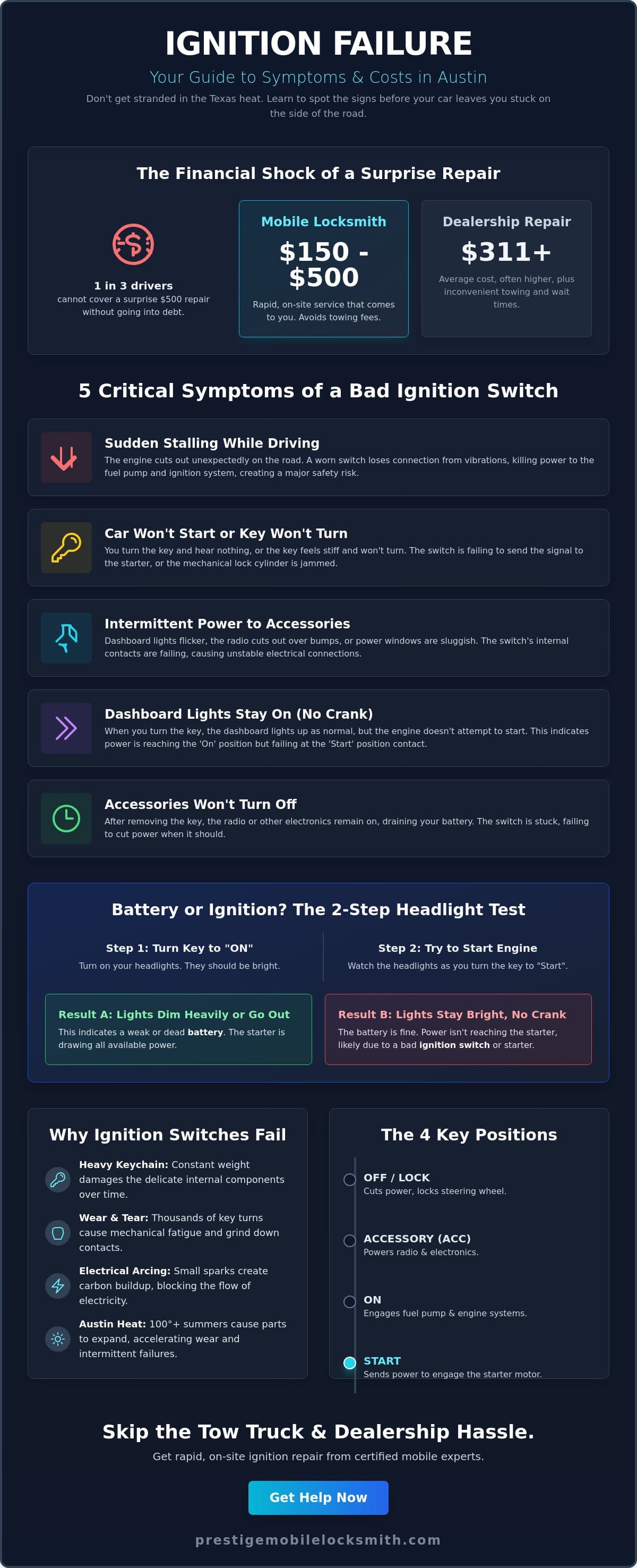
Your ignition switch operates in four distinct stages to manage your car's power. In the Off position, it secures the steering wheel and cuts all non-essential power. The Accessory (ACC) stage powers the radio and lights without draining the battery for start-up. Moving to the On position engages the fuel pump and engine management systems. Finally, the Start position creates a momentary high-draw connection that engages the starter motor. If the switch fails at any of these points, you'll experience different signs of a bad ignition switch, from a silent engine to a radio that won't turn off.
Common Reasons for Ignition Switch Wear
Why do these switches fail? Mechanical fatigue is the most common culprit. Thousands of turns over the vehicle's life eventually grind down the internal components. Your heavy keychain is another hidden enemy. The weight of dozens of keys pulls on the cylinder, which damages the delicate electrical contacts inside the switch. Additionally, electrical arcing can occur. This creates carbon buildup on the copper terminals, preventing a clean flow of electricity. Our certified technicians often find that heat expansion in Austin, especially during the 100 degree summers of 2026, accelerates this process. This causes intermittent contact failure in older housings. When this happens, you need a rapid, on-site solution to get back on the road without a tow truck. Driving on I-35 or MoPac requires your full attention. The last thing you need is your engine dying at 65 mph. Sudden stalling is one of the most dangerous signs of a bad ignition switch. Road vibrations can cause a worn internal contact to lose its connection. When this happens, the power to your ignition system and fuel pump cuts out instantly. You'll lose power steering and braking assist, making the car difficult to control. Many drivers mistake this for a failing fuel pump. However, if your dashboard lights go dark at the same time, the switch is likely the culprit. Another common headache is an engine that refuses to crank. You turn the key, but nothing happens. If your battery is healthy, the problem often lies in the "Start" position of the switch. It fails to send the necessary signal to the starter motor. To help narrow it down, you can ask yourself: Is It the Battery, Starter, or Ignition Switch? Professional diagnosis prevents you from spending money on a battery you don't need. This is vital since the average car repair now costs $838 as of May 2026. Intermittent power loss is another red flag. You might notice specific electronics acting up while the engine is running. These symptoms include:
Sudden Stalling and Engine Cut-Outs
When an ignition switch fails mid-drive, the results are immediate. The electrical bridge we discussed earlier collapses. Your engine management system loses power, and the vehicle shuts down. This creates a high-stakes safety risk on busy Austin streets. If your key feels "mushy" or doesn't click firmly into place, the mechanical components are likely failing. This physical wear prevents the electrical terminals from staying locked together during transit. Catching these signs of a bad ignition switch early can prevent a dangerous highway emergency.
Anti-Theft System and Immobilizer Issues
Modern vehicles use sophisticated security handshakes. Your ignition switch must communicate with the transponder chip in your key to allow the engine to run. A faulty switch breaks this communication. You might see the "Security" or "Anti-Theft" light stay on even after you try to start the car. Sometimes the engine will fire up but die after exactly two seconds. This is a classic immobilizer lockout. Because these systems are complex, you'll need a certified automotive car locksmith to reset the system and program the new switch. If you're seeing these symptoms, we can perform a rapid ignition repair at your home or office to get you back on the road fast. When your car refuses to start, the "Big Three" suspects are your battery, starter, and ignition switch. Systematically eliminating these prevents you from wasting money on parts that still work. A simple "Headlight Test" is your first step. Turn your headlights on and try to crank the engine. If the lights go dark, your battery lacks the power to turn the motor. If the lights stay bright but you hear nothing, you're likely seeing the primary signs of a bad ignition switch. This distinction saves you from an unnecessary tow to a dealership. Sound is your next diagnostic tool. A rapid clicking noise often points to a dead battery or a failing starter solenoid. A single loud "clunk" usually means the starter motor is physically jammed. Total silence, however, points directly to the ignition switch. It means the electrical signal never left the steering column. Understanding the locksmith cost Austin residents pay for a mobile service call, which typically ranges from $29 to $100 as of May 2026, is much cheaper than guessing with expensive parts. Prices for motor vehicle repair are 197.57% higher in 2026 than in 1997, so an accurate diagnosis is vital for your budget.
The Dashboard Light Diagnostic
Watch your instrument cluster carefully. When you move the key to the "On" position, the dashboard should light up. If it stays dark, the switch has failed to bridge the gap between the battery and the rest of the car. Sometimes you'll find the car starts fine, but you have no power in "Accessory" mode. This partial failure is one of the subtle signs of a bad ignition switch that many drivers ignore until they are stranded. Neglecting these symptoms can lead to the dangers of a faulty ignition switch, which has historically caused serious road accidents and injuries.
Starter vs. Switch: The Sound of Failure
Differentiating between a starter and a switch requires a logical approach. A starter failure is often loud and physical. A switch failure is quiet and electrical. If you have a multimeter, you can check for 12-volt power at the starter solenoid while someone turns the key. No power there means the switch is dead. The ignition switch is the most overlooked part of the starting circuit. Many people replace their starter only to find the car still won't turn over. We help you avoid this "parts cannon" approach with a rapid, accurate diagnosis at your location. This is essential since approximately one-third of drivers cannot cover a surprise $500 repair without going into debt this year. Austin's climate plays a massive role in your vehicle's reliability. While generic guides mention general wear and tear, they often ignore the brutal impact of 100°F+ Central Texas summers. High temperatures cause the plastic and metal components inside your steering column to expand at different rates. This expansion often leads to intermittent contact failure, especially in older ignition housings. You might find your car starts perfectly in the cool morning but refuses to turn over after sitting in a sun-drenched parking lot near Zilker Park all afternoon. These are classic signs of a bad ignition switch influenced by our local environment. Beyond the heat, dust and limestone debris from Austin's constant construction infiltrate the lock cylinder. This grit acts like sandpaper. It grinds down the internal pins every time you insert your key. Attempting a DIY repair in this high-heat, high-stress environment is risky. Without specialized tools, you might accidentally trigger the airbag or damage the delicate clock spring. This leads to even more expensive repairs that far exceed the cost of professional help. We bring the tools and the shade to you, ensuring the job is done right the first time.
Heat-Induced Electrical Resistance
Extreme heat doesn't just expand parts; it degrades the specialized grease inside the ignition lock cylinder. This grease is designed to keep mechanical movements smooth. When it thins out or dries up due to triple-digit temperatures, the mechanical action becomes stiff. This resistance puts extra strain on the electrical switch sitting behind the cylinder. If your key feels unusually hot to the touch when you remove it, take notice. Internal electrical arcing is likely generating that heat, which is one of the physical signs of a bad ignition switch you should never ignore.
The Heavy Keychain Problem
Austin's active lifestyle often leads to bulky key rings filled with house keys, gym tags, and heavy carabiners. Gravity is not your friend in this scenario. Every road bump on MoPac or I-35 turns that heavy keychain into a lever. It slowly pries the internal components of the switch apart. Over time, this weight destroys the alignment of the electrical terminals, leading to a "mushy" feel when you turn the key. Our experts recommend keeping your car key on a separate, lightweight ring to protect your ignition system from unnecessary mechanical stress. If your key is already sticking or your dashboard is flickering, don't wait for the next heatwave to leave you stranded. Contact us for professional ignition repair and get a reliable solution delivered to your doorstep today. Choosing between a dealership and a mobile locksmith is often the difference between a minor inconvenience and a week-long headache. Dealerships frequently require you to pay for a tow truck just to get your vehicle onto their lot. Once there, you might face a multi-day wait before a technician is even available. We eliminate the "Dealership Trap" by bringing the entire shop to your driveway. If you've identified the signs of a bad ignition switch, you need a solution that respects your time and your budget. Our rapid response team handles everything from the initial diagnosis to the final transponder programming on-site. Safety is our top priority during every repair. Modern steering columns house delicate components like airbags and clock springs. One wrong move during a DIY attempt can trigger a costly safety system failure or even physical injury. Our certified experts possess the training to navigate these high-tech systems safely. If your key is physically stuck or won't turn at all, we also provide an emergency lockout service Austin drivers can rely on 24/7. This comprehensive approach ensures your car is secured and functional without the need for multiple service appointments.
On-Site Diagnosis and Replacement
Precision matters when dealing with your vehicle's security. Our technicians typically diagnose ignition issues in under 30 minutes. We use specialized tools to remove the faulty switch without damaging the surrounding lock cylinder. This level of care is essential for maintaining your car's integrity. Once the new hardware is installed, we program it to work perfectly with your existing keys. You won't need to carry two different sets of keys or worry about transponder handshake errors. We ensure every electrical connection is solid and every security protocol is met before we leave.
The Cost-Benefit of Mobile Service
The financial math favors mobile service every time. While dealerships charge premium labor rates, mobile locksmiths in Austin offer ignition repair for between $150 and $500 as of May 2026. You also avoid the added expense of a tow, which can easily cost another $100. Our service call fees remain transparent, typically ranging from $29 to $100 depending on your location. This is a critical advantage since prices for motor vehicle repair have risen 197.57% since 1997. We provide 24/7 availability for night-shift workers and commuters who can't wait for a shop to open at 9 AM. Contact Prestige Mobile Locksmith for rapid ignition repair in Austin and let us bring the solution directly to you. Recognizing the signs of a bad ignition switch early is the key to avoiding a high-stakes roadside emergency. You now know how to distinguish between a simple battery jump and a complex electrical failure. You also understand why Austin's triple-digit heat makes your vehicle's ignition system more vulnerable than in other regions. Don't let a failing switch turn into an expensive dealership ordeal involving towing fees and long wait times. Our licensed and insured Austin technicians are ready to bring the solution to your doorstep. We maintain a 30-minute average response time to ensure you aren't left waiting in the heat. With advanced ECU and transponder programming tools, we handle even the most modern security systems right on-site. We take pride in being your neighborly experts who prioritize your safety and your schedule. We're proactive problem-solvers dedicated to getting you moving again. Call Prestige Mobile Locksmith now for 24/7 mobile ignition repair in Austin! You deserve a reliable fix that gets you back to your life without the stress of a traditional shop.
Can a bad ignition switch cause my car to lose power while driving?
Yes, a faulty switch can cause your engine to shut off instantly while you are in motion. This happens when worn internal contacts lose their connection due to road vibrations or heat expansion. It is a dangerous situation that often occurs on high speed Austin roads like MoPac. You will lose power steering and braking assist, so pull over safely as soon as you feel the engine sputter.
Will a bad ignition switch drain my battery overnight?
A failing switch can definitely drain your battery if it gets stuck in the "Accessory" or "On" position. Even if you remove the key, the internal terminals might stay connected. This keeps your car's computer and electrical relays active. If you notice your radio stays on or your dashboard remains lit after you leave the vehicle, these are clear signs of a bad ignition switch that requires immediate attention.
How much does it typically cost to replace an ignition switch in Austin?
Mobile locksmiths in Austin currently advertise ignition repair services ranging from $150 to $500 as of May 2026. This price varies based on your vehicle's specific make and model. Choosing a mobile service helps you avoid the average $100 towing fee required to reach a dealership. We provide a transparent quote before we begin any work at your location.
Is it possible to start a car with a bad ignition switch?
You might be able to start the car temporarily by wiggling the key or turning it with extra force, but this is a temporary fix. These inconsistent starts are early signs of a bad ignition switch that will eventually lead to total failure. Relying on a wobbly connection is risky. You don't want to find yourself stranded in a grocery store parking lot during a 100 degree Texas afternoon.
How do I know if it's my key or the ignition switch that is the problem?
Test your ignition with a spare key to narrow down the culprit. If the spare key works perfectly, your primary key is likely worn down or damaged. If the spare key also fails to turn or start the engine, the problem lies within the ignition cylinder or the electrical switch behind it. We can diagnose both issues on-site and provide a rapid solution.
Can a locksmith replace an ignition switch, or do I need a mechanic?
A mobile locksmith is often the most efficient choice for this specific repair. We specialize in the mechanical lock cylinder and the electrical switch assembly. Unlike a general mechanic, we also carry the specialized tools needed for transponder key programming and ECU reflash services. We bring the shop to you, saving you time and the stress of a dealership visit.
What happens if my anti-theft light comes on when I try to start the car?
An illuminated anti-theft light usually means the car doesn't recognize your key's security chip. A bad ignition switch can break the communication link between the key and the immobilizer system. When this handshake fails, the engine might crank but won't "fire" or it may die after two seconds. Our technicians use advanced diagnostic tools to reset these security protocols and get you moving again.
How long does a professional ignition switch replacement take?
Most professional ignition replacements take between 30 and 60 minutes once the technician arrives. Our mobile units are fully stocked with common parts to ensure we finish the job in a single visit. We work quickly to minimize your downtime. Our goal is to provide a reliable, rapid resolution that gets you back to your schedule without unnecessary delays.
