
Best Smart Locks for Austin Weather: A 2026 Guide to Heat-Resistant Security
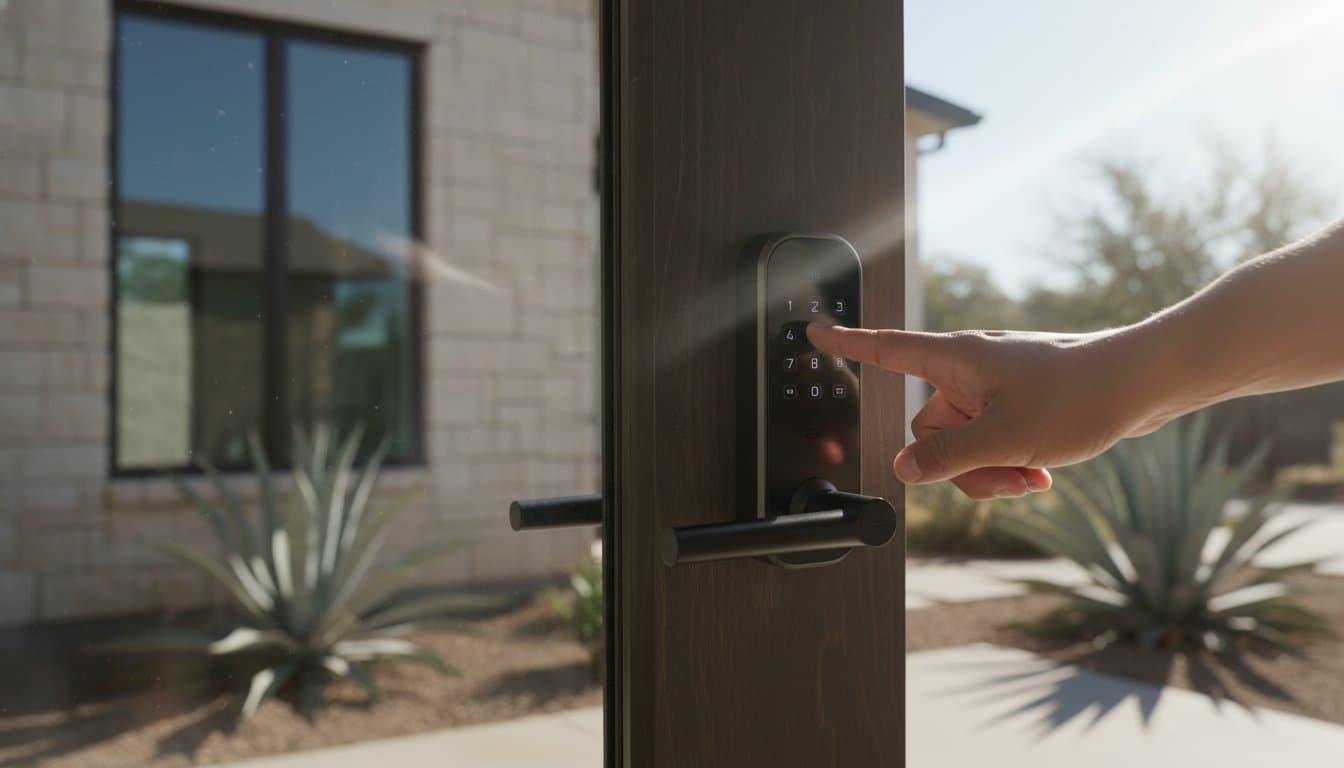
Imagine standing on your doorstep in mid-August with the sun beating down at a relentless 105°F. You reach for your keypad, but the screen is unresponsive. Perhaps the motorized bolt is jammed because your door frame expanded in the heavy humidity. Finding the best smart locks for Austin weather is about more than just convenience. It's about ensuring your home remains accessible when the Texas climate tries its best to break your tech.
We know how stressful it is to be locked out by the very device meant to keep you safe. You need a security system that works 100% of the time, regardless of the triple-digit heat. This guide shows you which heat-resistant models actually survive our brutal summers and how to maintain peak battery life. We also look at how expert smart lock installation prevents the common mechanical jams that plague local homeowners every July. You will learn how to choose hardware with the right IP65 ratings and mechanical tolerances to handle the "Austin Jam" without failing when you need them most.
Key Takeaways
- See how the "Heat Sink" effect and Central Texas humidity can ruin cheap electronics. Learn to pick hardware that resists internal corrosion.
- Identify the best smart locks for Austin weather that feature ANSI Grade 1 durability. These models withstand triple-digit heat and sudden flash floods.
- Master the "Friction Test" to stop the notorious "Austin Jam." Find out why 3-inch screws are mandatory for a secure, functional door frame.
- Discover why professional smart lock installation beats the "big box" store approach. Get expert calibration that keeps your lock moving freely year-round.
Why Austin Weather is the Ultimate Test for Smart Locks
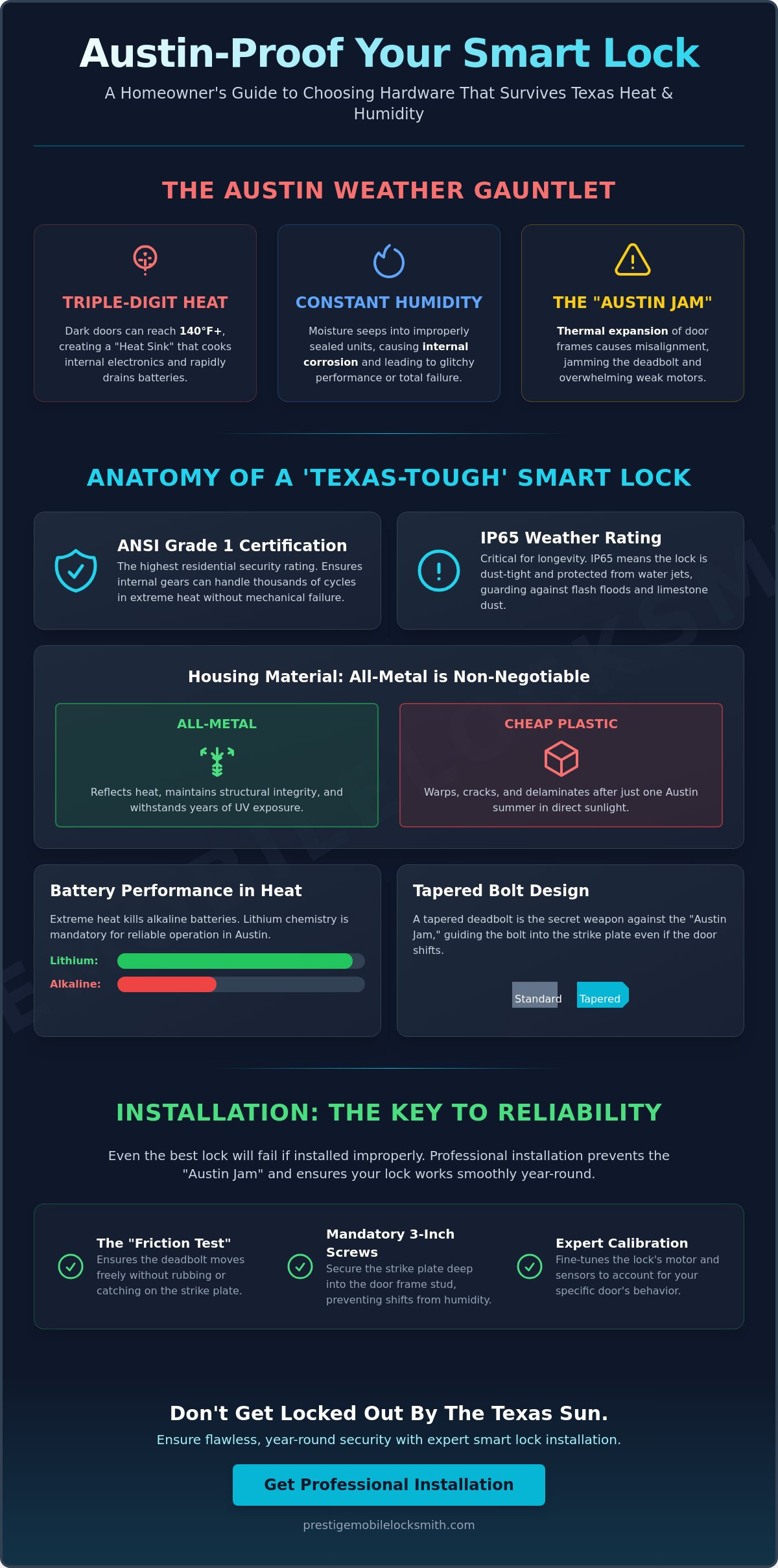
Austin summers are more than just uncomfortable; they are a mechanical nightmare for home security. When the thermometer hits triple digits, your front door becomes a radiator. Dark-colored doors are especially vulnerable because they act as a "Heat Sink." In direct sunlight, a black or dark bronze door can reach temperatures exceeding 140°F. This intense heat transfers directly into the lock hardware, cooking the delicate circuit boards inside. Choosing the best smart locks for Austin weather requires hardware designed to dissipate this heat before it fries the system.
Humidity is the second silent killer in Central Texas. Moisture in the air leads to internal corrosion in cheaper models that lack proper weather sealing. Before you invest, it helps to understand what is a smart lock and how its sensitive components react to our local environment. Without a high IP65 rating, humidity seeps into the casing and causes the electronics to glitch or fail entirely. You don't want to find out your lock is corroded during a July thunderstorm.
Thermal expansion also plays a major role in lock failure. As temperatures spike, wood and metal frames shift and expand. This movement often misaligns the bolt and the strike plate. If your smart lock has a weak motor, it won't be able to overcome this "Austin Jam." We always suggest the "30-Minute Rule" for local homeowners. Every smart device should have a physical key override. If the electronics fail due to heat or a jammed bolt, you must be able to get inside your home within seconds using a traditional key.
Direct Sunlight and Touchscreen Failure
UV rays are a primary cause of touchscreen degradation. Over time, the sun breaks down the capacitive layers on glass screens. This leads to "ghost touches" or a total loss of sensitivity. In the bright Austin light, high-contrast displays are necessary for visibility. However, physical buttons often outperform touchscreens in our climate. They don't delaminate or become unresponsive when the surface temperature spikes. If your door faces west, a button-based keypad is usually the more reliable choice.
Battery Drain in Extreme Temperatures
Extreme heat increases the internal resistance of your batteries. This forces the lock to work harder to pull power, significantly shortening the "smart" standby time. Standard alkaline batteries often leak or fail when the temperature inside the lock housing stays high for weeks. Lithium batteries are mandatory for Austin summers. They are chemically stable in high heat and provide consistent voltage. If you notice your lock responding slowly or losing its Wi-Fi connection in August, the climate is likely draining your power source.
Core Features of a 'Texas-Tough' Smart Lock
Austin homes require more than just a pretty keypad. You need hardware built to survive relentless UV exposure and heavy humidity. When you shop for the best smart locks for Austin weather, start with ANSI Grade 1 Certification. This is the highest residential security rating available. It ensures internal gears can handle thousands of cycles even when Texas heat causes metal parts to expand. Standard locks often fail after a few seasons. Grade 1 is built for the long haul and offers the mechanical endurance our climate demands.
IP65 ratings are just as critical for local longevity. This rating means the lock is dust-tight and protected against water jets. In Austin, this protects your investment from sudden flash floods and the fine limestone dust that blows through our neighborhoods. Avoid plastic trim at all costs. Cheap plastic housings warp and crack after just one summer in direct sun. All-metal housings are far superior. They reflect heat and maintain structural integrity over years of exposure. Technical smart lock performance evaluations confirm that material durability is the primary defense against environmental failure.
Tapered bolt designs are the secret weapon against the "Austin Jam." A tapered deadbolt is slightly narrower at the tip. This helps it slide into the strike plate even if the door shifts due to moisture. If you're unsure about your current door alignment, a professional smart lock installation can correct these issues before they lead to a lockout. A properly fitted lock shouldn't require you to pull or push the door just to get the bolt to turn.
Mechanical vs. Fully Motorized Deadbolts
Fully motorized bolts sound convenient, but they use significant battery power to push through a swollen door frame. Manual-turn smart locks, like some August models, often perform better in the Austin heat. You provide the physical force to turn the bolt, which saves the motor from burning out. If you prefer a motorized version, ensure it has a "clutch" mechanism. This protects the internal gears from stripping if the bolt hits an obstruction caused by thermal expansion.
Connectivity Standards That Survive Interference
Austin is a major tech hub. Our neighborhoods are packed with wireless signals that can interfere with your security. Thread and Z-Wave protocols are often more stable than standard Wi-Fi because they don't have to compete with your neighbors' routers. Local-control hubs are also a lifesaver during Texas grid fluctuations. They keep your lock functional even if the internet goes dark. Always verify that your lock supports offline access codes so you can still get inside during a power surge.
Top 3 Smart Locks for Austin Homes in 2026
Picking a lock from a top-ten list is easy. Picking one that won't die in July is much harder. Our technicians spend all summer replacing "smart" locks that simply weren't built for Central Texas. The sun is a brutal critic. These three models represent the best smart locks for Austin weather because they prioritize mechanical strength over flashy, fragile features. We've seen these units withstand the 100-degree days that leave other brands unresponsive and glitched out.
The Heavyweight Champion: Schlage Encode Plus
The Schlage Encode Plus is the gold standard for a reason. It features a high-torque motor designed to handle heavy, solid-core doors that often swell in our humidity. While other locks might jam and beep in frustration, the Encode Plus has the power to force the bolt into the strike plate. It also features a built-in forced-entry alarm, which provides an immediate deterrent if someone tries to tamper with your door. Most importantly, it includes a physical key override. If the electronics ever fail in the 105-degree heat, you aren't stuck on your porch. We've found that its battery performance remains consistent even when the door's exterior temperature spikes, making it a reliable workhorse for any Austin neighborhood.
The Versatile Choice: Yale Assure Lock 2
The Yale Assure Lock 2 is a favorite for its modular design. You can choose between keyed or key-free versions depending on your family's needs. For Austin commuters who are always in a rush, the "Auto-Lock" feature is a lifesaver. It ensures your home is secure the moment the door closes behind you. This model has a remarkably small footprint on the door face. This isn't just about aesthetics; less surface area means less heat absorption from direct afternoon sunlight. By reducing the "Heat Sink" effect, the internal components stay cooler and last longer. It’s a smart, sleek option that doesn't sacrifice durability for style.
The Best Retrofit: August Wi-Fi Smart Lock (4th Gen)
If you already have a high-security deadbolt and don't want to replace it, the August Wi-Fi Smart Lock is your best bet. It installs on the inside of your door, meaning the sensitive electronics and batteries stay in the air conditioning. Your existing exterior hardware remains untouched, which is perfect for preserving the look of your home while adding modern tech. This "adapter" style is inherently more protected from UV rays and rain than all-in-one units.
Our field notes show that most failures in Austin happen because of poor alignment during professional locksmith installation. When a lock has to fight a shifting door frame, the motor burns out. Whether you choose Schlage, Yale, or August, ensuring the hardware is calibrated for your specific residential locksmith Austin setup is the only way to guarantee it works every time you come home.
Installation Secrets: Preventing the 'Austin Jam'
Even the best smart locks for Austin weather will fail if the installation doesn't account for thermal expansion. In Central Texas, your door is a living thing. It expands in the afternoon heat and contracts during a cool night. This movement creates the "Austin Jam," where a motorized bolt hits the strike plate instead of sliding into the hole. To stop this, deep-setting the strike plate is mandatory. Don't use the tiny screws that come in the box. Use 3-inch screws that reach through the frame and into the wall stud. This keeps the hardware stable even as the house shifts.
Always perform the "Friction Test" before you call the job finished. You should be able to turn the lock smoothly without pulling, pushing, or lifting the door handle. If there is any resistance, your motor is working too hard. It will eventually burn out. Balance your weatherstripping carefully. You want to seal out the 105-degree air, but the seal shouldn't put constant pressure on the bolt. For maintenance, use dry graphite or teflon spray. Never use oily lubricants like WD-40. They attract the fine limestone dust common in Austin, which creates a gritty paste that ruins smart lock gears.
Correcting Door Misalignment
Austin's clay-heavy soil causes foundations to settle and shift constantly. If your door has "dropped" even a fraction of an inch, your smart lock will jam. You can often fix this by filing the strike plate opening to create a wider target for the bolt. However, this requires precision to maintain security. A professional smart lock installation ensures your door is perfectly hung and aligned. This simple correction can save you from an expensive motor replacement later.
Optimizing Battery Life
Heat drains batteries faster than almost anything else. In Austin, skip the generic alkaline batteries. Use high-quality lithium cells designed for extreme temperatures. They are less likely to leak and provide a steady voltage during a heatwave. Check your smart home app for "Power Save" settings to reduce unnecessary pings. The #1 battery killer in larger Austin homes is a weak Wi-Fi signal. If your lock is constantly "searching" for a connection through thick limestone walls, the battery will die in weeks. Use a mesh extender to keep the signal strong and the power consumption low.
Don't wait for a lockout to realize your door has shifted. Contact us for expert smart lock installation to ensure your home stays secure all summer long.
Why Professional Austin Locksmiths are Your Best Bet
Buying a lock at a big-box retail store is often a gamble. Those generic SKUs are mass-produced for moderate climates and don't always feature the heavy-duty gaskets required for Central Texas. You need the best smart locks for Austin weather, which often means sourcing industrial-grade hardware that stays cool under pressure. We provide professional-grade components that offer superior UV resistance compared to the thin plastic trims found on retail shelves. Choosing the right hardware is the first step toward a lock that lasts more than a single summer.
Expert calibration is what separates a functional lock from a constant headache. A pro ensures your new technology integrates perfectly with your existing residential locksmith Austin setup. We don't just tighten two screws and leave. We analyze the strike plate alignment and frame depth to account for future thermal expansion. This precision prevents the motor from struggling against a shifting door, which is the primary cause of premature hardware failure in our region. We use specialized tools to ensure the "Friction Test" passes even when the humidity is at its peak.
Mobile Service That Comes to You
Lock failures never happen at a convenient time. If your smart lock becomes unresponsive at 2 AM in Round Rock, you need a solution that moves toward you. We offer mobile support across the entire Austin metro area with under 30-minute response times for emergency lockouts. Our vans are fully equipped mobile workshops. We can rekey cylinders, program fobs, or replace fried circuit boards right in your driveway. Since 2012, we've focused on being a dependable, local figure for our neighbors. We maintain a friendly, professional vibe to lower your anxiety during stressful security upgrades or unexpected failures.
Integrated Security Solutions
A smart lock is just one piece of a modern home security puzzle. Many local homeowners are now combining their best smart locks for Austin weather with professional CCTV installation. This creates total home awareness, allowing you to verify visitors visually before granting access through your phone. We also specialize in:
- Master key system setup for backup physical access
- High-security lock installation to supplement smart tech
- Deadbolt repair for doors that have shifted over time
- Access control system installation for home offices
Don't let the Texas sun compromise your safety. Contact Prestige Mobile Locksmith for a Smart Lock Consultation today. We'll ensure your home stays secure, accessible, and cool, no matter how high the temperature climbs.
Upgrade Your Home Security Before the Next Heatwave
Don't let the Central Texas sun dictate your home's security. Choosing the best smart locks for Austin weather is about more than just picking a brand. It requires hardware that handles thermal expansion and professional installation that accounts for our shifting soil. We've seen how 105-degree heat can warp doors and drain batteries. You need a setup that remains reliable every single day.
Our team has been serving the local community since 2012. We provide 24/7 emergency mobile service to ensure you're never left on the porch. With licensed and insured technicians, we handle the technical calibration so you don't have to worry about a jammed bolt in August. We bring the solutions directly to your door so you can focus on staying cool. Get the peace of mind you deserve with a lock built for the Texas climate.
Secure Your Austin Home with Expert Smart Lock Installation
We are ready to help you upgrade your security today. Your safety is our priority.
Frequently Asked Questions
Will the Austin heat melt my smart lock's internal components?
The heat won't physically melt the metal casing, but it can definitely fry the delicate circuit boards inside. Dark colored doors in direct sunlight often reach temperatures over 140°F. This intense heat transfers to the electronics and causes them to glitch or fail. Look for models with all-metal housings that are specifically designed to dissipate heat and protect the internal processor.
How often do I need to change smart lock batteries in the Texas summer?
You should plan to replace your batteries every 3 to 6 months during the peak of the Texas summer. Finding the best smart locks for Austin weather means looking for models with efficient power management, but the heat still increases internal resistance. Always use high quality lithium batteries. They are chemically stable at higher temperatures and won't leak inside your hardware like standard alkaline cells.
What happens to my smart lock if the power goes out during an Austin storm?
Your smart lock will continue to work because it runs on internal batteries rather than your home's electrical grid. Most models store your access codes locally on the device so you can still get inside even if your Wi-Fi is down. Some keyless designs even feature a 9V battery jump start port on the exterior. This allows you to provide temporary power if the internal batteries die during a long outage.
Can I still use a physical key with a smart lock?
You can absolutely use a physical key if you choose a smart lock model that includes a traditional keyway. We highly recommend these keyed versions for local homeowners. Having a mechanical backup is the only way to guarantee entry if the electronics fail due to extreme heat or a dead battery. It provides a necessary layer of reliability when you need to get inside quickly.
Why does my smart lock jam more often in the summer than in the winter?
Your lock jams because the wood and metal in your door and frame expand in the high heat and humidity. This shifting misaligns the bolt and the strike plate, a problem commonly known as the "Austin Jam." Professional calibration ensures the bolt has enough clearance to move freely even when the materials swell. This prevents the motor from burning out while trying to force the door shut.
Are smart locks as secure as traditional high-security deadbolts?
Smart locks are just as secure as traditional deadbolts if they carry an ANSI Grade 1 rating. This is the highest residential security standard available. Many smart models also include built-in tamper alarms and logs that track who enters your home. Combining a smart lock with professional high-security lock installation gives you both modern convenience and the physical strength of a traditional deadbolt.
Does direct sunlight affect the fingerprint reader on smart locks?
Direct sunlight can interfere with the accuracy of fingerprint sensors and cause them to respond slowly. UV rays can also degrade the scanner surface over time, leading to a loss of sensitivity. If your front door faces the afternoon sun, consider a model with a physical keypad or a protective shield. This ensures the reader remains functional and recognizes your print in 0.3 seconds or less.
Is professional installation really necessary for a smart lock?
Professional installation is vital for ensuring the long term health of your lock's motor. A pro doesn't just mount the hardware; they align the door and frame to prevent mechanical binding. We use 3-inch screws to reinforce the strike plate into the wall stud for maximum security. This precision prevents the "Austin Jam" and ensures your smart lock works 100% of the time regardless of the temperature.
Frequently Asked Questions
Direct Sunlight and Touchscreen Failure
UV rays are a primary cause of touchscreen degradation. Over time, the sun breaks down the capacitive layers on glass screens. This leads to "ghost touches" or a total loss of sensitivity. In the bright Austin light, high-contrast displays are necessary for visibility. However, physical buttons often outperform touchscreens in our climate. They don't delaminate or become unresponsive when the surface temperature spikes. If your door faces west, a button-based keypad is usually the more reliable choice.
Battery Drain in Extreme Temperatures
Extreme heat increases the internal resistance of your batteries. This forces the lock to work harder to pull power, significantly shortening the "smart" standby time. Standard alkaline batteries often leak or fail when the temperature inside the lock housing stays high for weeks. Lithium batteries are mandatory for Austin summers. They are chemically stable in high heat and provide consistent voltage. If you notice your lock responding slowly or losing its Wi-Fi connection in August, the climate is likely draining your power source. Austin homes require more than just a pretty keypad. You need hardware built to survive relentless UV exposure and heavy humidity. When you shop for the best smart locks for Austin weather, start with ANSI Grade 1 Certification. This is the highest residential security rating available. It ensures internal gears can handle thousands of cycles even when Texas heat causes metal parts to expand. Standard locks often fail after a few seasons. Grade 1 is built for the long haul and offers the mechanical endurance our climate demands. IP65 ratings are just as critical for local longevity. This rating means the lock is dust-tight and protected against water jets. In Austin, this protects your investment from sudden flash floods and the fine limestone dust that blows through our neighborhoods. Avoid plastic trim at all costs. Cheap plastic housings warp and crack after just one summer in direct sun. All-metal housings are far superior. They reflect heat and maintain structural integrity over years of exposure. Technical smart lock performance evaluations confirm that material durability is the primary defense against environmental failure. Tapered bolt designs are the secret weapon against the "Austin Jam." A tapered deadbolt is slightly narrower at the tip. This helps it slide into the strike plate even if the door shifts due to moisture. If you're unsure about your current door alignment, a professional smart lock installation can correct these issues before they lead to a lockout. A properly fitted lock shouldn't require you to pull or push the door just to get the bolt to turn.
Mechanical vs. Fully Motorized Deadbolts
Fully motorized bolts sound convenient, but they use significant battery power to push through a swollen door frame. Manual-turn smart locks, like some August models, often perform better in the Austin heat. You provide the physical force to turn the bolt, which saves the motor from burning out. If you prefer a motorized version, ensure it has a "clutch" mechanism. This protects the internal gears from stripping if the bolt hits an obstruction caused by thermal expansion.
Connectivity Standards That Survive Interference
Austin is a major tech hub. Our neighborhoods are packed with wireless signals that can interfere with your security. Thread and Z-Wave protocols are often more stable than standard Wi-Fi because they don't have to compete with your neighbors' routers. Local-control hubs are also a lifesaver during Texas grid fluctuations. They keep your lock functional even if the internet goes dark. Always verify that your lock supports offline access codes so you can still get inside during a power surge. Picking a lock from a top-ten list is easy. Picking one that won't die in July is much harder. Our technicians spend all summer replacing "smart" locks that simply weren't built for Central Texas. The sun is a brutal critic. These three models represent the best smart locks for Austin weather because they prioritize mechanical strength over flashy, fragile features. We've seen these units withstand the 100-degree days that leave other brands unresponsive and glitched out.
The Heavyweight Champion: Schlage Encode Plus
The Schlage Encode Plus is the gold standard for a reason. It features a high-torque motor designed to handle heavy, solid-core doors that often swell in our humidity. While other locks might jam and beep in frustration, the Encode Plus has the power to force the bolt into the strike plate. It also features a built-in forced-entry alarm, which provides an immediate deterrent if someone tries to tamper with your door. Most importantly, it includes a physical key override. If the electronics ever fail in the 105-degree heat, you aren't stuck on your porch. We've found that its battery performance remains consistent even when the door's exterior temperature spikes, making it a reliable workhorse for any Austin neighborhood.
The Versatile Choice: Yale Assure Lock 2
The Yale Assure Lock 2 is a favorite for its modular design. You can choose between keyed or key-free versions depending on your family's needs. For Austin commuters who are always in a rush, the "Auto-Lock" feature is a lifesaver. It ensures your home is secure the moment the door closes behind you. This model has a remarkably small footprint on the door face. This isn't just about aesthetics; less surface area means less heat absorption from direct afternoon sunlight. By reducing the "Heat Sink" effect, the internal components stay cooler and last longer. It’s a smart, sleek option that doesn't sacrifice durability for style.
The Best Retrofit: August Wi-Fi Smart Lock (4th Gen)
If you already have a high-security deadbolt and don't want to replace it, the August Wi-Fi Smart Lock is your best bet. It installs on the inside of your door, meaning the sensitive electronics and batteries stay in the air conditioning. Your existing exterior hardware remains untouched, which is perfect for preserving the look of your home while adding modern tech. This "adapter" style is inherently more protected from UV rays and rain than all-in-one units. Our field notes show that most failures in Austin happen because of poor alignment during professional locksmith installation. When a lock has to fight a shifting door frame, the motor burns out. Whether you choose Schlage, Yale, or August, ensuring the hardware is calibrated for your specific residential locksmith Austin setup is the only way to guarantee it works every time you come home. Even the best smart locks for Austin weather will fail if the installation doesn't account for thermal expansion. In Central Texas, your door is a living thing. It expands in the afternoon heat and contracts during a cool night. This movement creates the "Austin Jam," where a motorized bolt hits the strike plate instead of sliding into the hole. To stop this, deep-setting the strike plate is mandatory. Don't use the tiny screws that come in the box. Use 3-inch screws that reach through the frame and into the wall stud. This keeps the hardware stable even as the house shifts. Always perform the "Friction Test" before you call the job finished. You should be able to turn the lock smoothly without pulling, pushing, or lifting the door handle. If there is any resistance, your motor is working too hard. It will eventually burn out. Balance your weatherstripping carefully. You want to seal out the 105-degree air, but the seal shouldn't put constant pressure on the bolt. For maintenance, use dry graphite or teflon spray. Never use oily lubricants like WD-40. They attract the fine limestone dust common in Austin, which creates a gritty paste that ruins smart lock gears.
Correcting Door Misalignment
Austin's clay-heavy soil causes foundations to settle and shift constantly. If your door has "dropped" even a fraction of an inch, your smart lock will jam. You can often fix this by filing the strike plate opening to create a wider target for the bolt. However, this requires precision to maintain security. A professional smart lock installation ensures your door is perfectly hung and aligned. This simple correction can save you from an expensive motor replacement later.
Optimizing Battery Life
Heat drains batteries faster than almost anything else. In Austin, skip the generic alkaline batteries. Use high-quality lithium cells designed for extreme temperatures. They are less likely to leak and provide a steady voltage during a heatwave. Check your smart home app for "Power Save" settings to reduce unnecessary pings. The #1 battery killer in larger Austin homes is a weak Wi-Fi signal. If your lock is constantly "searching" for a connection through thick limestone walls, the battery will die in weeks. Use a mesh extender to keep the signal strong and the power consumption low. Don't wait for a lockout to realize your door has shifted. Contact us for expert smart lock installation to ensure your home stays secure all summer long. Buying a lock at a big-box retail store is often a gamble. Those generic SKUs are mass-produced for moderate climates and don't always feature the heavy-duty gaskets required for Central Texas. You need the best smart locks for Austin weather, which often means sourcing industrial-grade hardware that stays cool under pressure. We provide professional-grade components that offer superior UV resistance compared to the thin plastic trims found on retail shelves. Choosing the right hardware is the first step toward a lock that lasts more than a single summer. Expert calibration is what separates a functional lock from a constant headache. A pro ensures your new technology integrates perfectly with your existing residential locksmith Austin setup. We don't just tighten two screws and leave. We analyze the strike plate alignment and frame depth to account for future thermal expansion. This precision prevents the motor from struggling against a shifting door, which is the primary cause of premature hardware failure in our region. We use specialized tools to ensure the "Friction Test" passes even when the humidity is at its peak.
Mobile Service That Comes to You
Lock failures never happen at a convenient time. If your smart lock becomes unresponsive at 2 AM in Round Rock, you need a solution that moves toward you. We offer mobile support across the entire Austin metro area with under 30-minute response times for emergency lockouts. Our vans are fully equipped mobile workshops. We can rekey cylinders, program fobs, or replace fried circuit boards right in your driveway. Since 2012, we've focused on being a dependable, local figure for our neighbors. We maintain a friendly, professional vibe to lower your anxiety during stressful security upgrades or unexpected failures.
Integrated Security Solutions
A smart lock is just one piece of a modern home security puzzle. Many local homeowners are now combining their best smart locks for Austin weather with professional CCTV installation. This creates total home awareness, allowing you to verify visitors visually before granting access through your phone. We also specialize in: Master key system setup for backup physical access High-security lock installation to supplement smart tech Deadbolt repair for doors that have shifted over time Access control system installation for home offices Don't let the Texas sun compromise your safety. Contact Prestige Mobile Locksmith for a Smart Lock Consultation today. We'll ensure your home stays secure, accessible, and cool, no matter how high the temperature climbs. Don't let the Central Texas sun dictate your home's security. Choosing the best smart locks for Austin weather is about more than just picking a brand. It requires hardware that handles thermal expansion and professional installation that accounts for our shifting soil. We've seen how 105-degree heat can warp doors and drain batteries. You need a setup that remains reliable every single day. Our team has been serving the local community since 2012. We provide 24/7 emergency mobile service to ensure you're never left on the porch. With licensed and insured technicians, we handle the technical calibration so you don't have to worry about a jammed bolt in August. We bring the solutions directly to your door so you can focus on staying cool. Get the peace of mind you deserve with a lock built for the Texas climate. Secure Your Austin Home with Expert Smart Lock Installation We are ready to help you upgrade your security today. Your safety is our priority.
Will the Austin heat melt my smart lock's internal components?
The heat won't physically melt the metal casing, but it can definitely fry the delicate circuit boards inside. Dark colored doors in direct sunlight often reach temperatures over 140°F. This intense heat transfers to the electronics and causes them to glitch or fail. Look for models with all-metal housings that are specifically designed to dissipate heat and protect the internal processor.
How often do I need to change smart lock batteries in the Texas summer?
You should plan to replace your batteries every 3 to 6 months during the peak of the Texas summer. Finding the best smart locks for Austin weather means looking for models with efficient power management, but the heat still increases internal resistance. Always use high quality lithium batteries. They are chemically stable at higher temperatures and won't leak inside your hardware like standard alkaline cells.
What happens to my smart lock if the power goes out during an Austin storm?
Your smart lock will continue to work because it runs on internal batteries rather than your home's electrical grid. Most models store your access codes locally on the device so you can still get inside even if your Wi-Fi is down. Some keyless designs even feature a 9V battery jump start port on the exterior. This allows you to provide temporary power if the internal batteries die during a long outage.
Can I still use a physical key with a smart lock?
You can absolutely use a physical key if you choose a smart lock model that includes a traditional keyway. We highly recommend these keyed versions for local homeowners. Having a mechanical backup is the only way to guarantee entry if the electronics fail due to extreme heat or a dead battery. It provides a necessary layer of reliability when you need to get inside quickly.
Why does my smart lock jam more often in the summer than in the winter?
Your lock jams because the wood and metal in your door and frame expand in the high heat and humidity. This shifting misaligns the bolt and the strike plate, a problem commonly known as the "Austin Jam." Professional calibration ensures the bolt has enough clearance to move freely even when the materials swell. This prevents the motor from burning out while trying to force the door shut.
Are smart locks as secure as traditional high-security deadbolts?
Smart locks are just as secure as traditional deadbolts if they carry an ANSI Grade 1 rating. This is the highest residential security standard available. Many smart models also include built-in tamper alarms and logs that track who enters your home. Combining a smart lock with professional high-security lock installation gives you both modern convenience and the physical strength of a traditional deadbolt.
Does direct sunlight affect the fingerprint reader on smart locks?
Direct sunlight can interfere with the accuracy of fingerprint sensors and cause them to respond slowly. UV rays can also degrade the scanner surface over time, leading to a loss of sensitivity. If your front door faces the afternoon sun, consider a model with a physical keypad or a protective shield. This ensures the reader remains functional and recognizes your print in 0.3 seconds or less.
Is professional installation really necessary for a smart lock?
Professional installation is vital for ensuring the long term health of your lock's motor. A pro doesn't just mount the hardware; they align the door and frame to prevent mechanical binding. We use 3-inch screws to reinforce the strike plate into the wall stud for maximum security. This precision prevents the "Austin Jam" and ensures your smart lock works 100% of the time regardless of the temperature.
