
ECM / PCM Reflash & Module Reprogramming in Austin, TX
Professional on-site reprogramming for engine, powertrain, transmission, body, and security modules. We synchronize all modules so your vehicle starts, shifts, and communicates correctly · no tow truck needed.
Modules We Reprogram
Select a module below to learn what it controls, common failure symptoms, and why reflashing may be required.
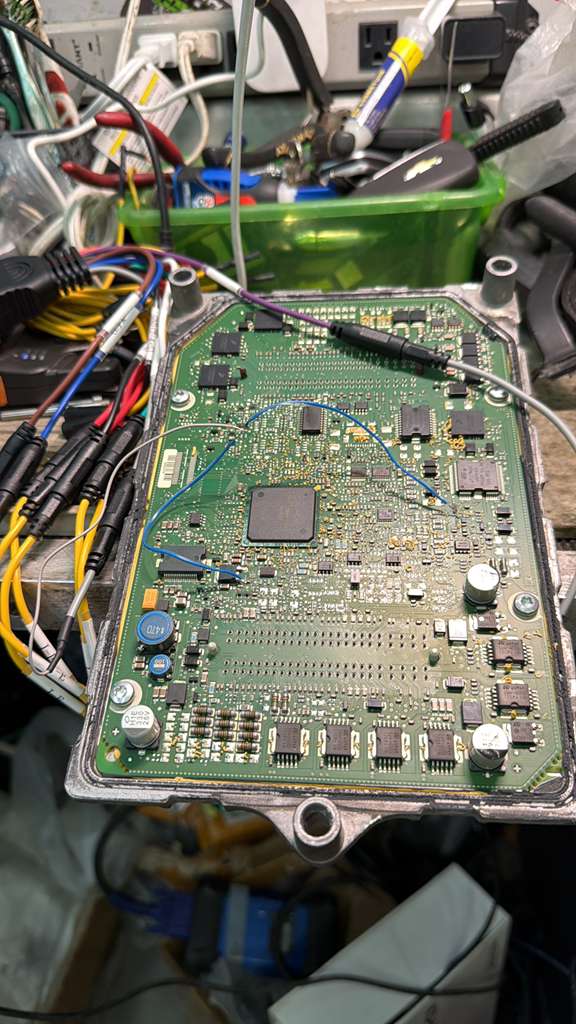
Engine Control Module
The ECM is the brain of your engine. It continuously monitors sensors throughout the engine and adjusts fuel injection timing, ignition timing, idle speed, and emissions output in real time.
⚙️ Key Functions
- ✓Fuel injection timing and duration
- ✓Ignition spark timing
- ✓Variable valve timing (VVT) control
- ✓Emissions system management (O2 sensors, EGR)
- ✓Idle speed regulation
- ✓Knock sensor response
- ✓Cold start enrichment
⚠️ Failure Symptoms
- •Check engine light (CEL) illuminated
- •Poor fuel economy
- •Rough idle or misfires
- •Engine stalling or hard starting
- •Failed emissions test
- •Reduced power or performance
🔧 Why Reflash / Reprogram?
- →OEM software update to fix factory bugs
- →Replace a failed/damaged ECM with a used unit
- →Performance tuning (custom calibration)
- →Adapting to modified hardware (injectors, cam, turbo)
- →VIN re-coding after module swap
Why Module Synchronization Is Critical
Installing a replacement module is only half the job. Modern vehicles run a network of 10–30+ computers that communicate over the CAN bus. If even one module is not properly programmed and synchronized, the entire network can fail · causing a no-start condition, persistent fault codes, or unpredictable behavior.
Every control module in your vehicle carries a unique identifier tied to your VIN, security tokens shared with the immobilizer and BCM, and learned calibration data built up over thousands of miles. When a module is replaced · even with a brand-new OEM unit · it must go through a structured synchronization process before the vehicle will operate correctly.
VIN Coding
The new module is flashed with your vehicle's unique VIN so it identifies itself correctly on the CAN bus network.
Calibration Transfer
Learned adaptations (fuel trims, shift adaptations, idle relearn) are transferred or reset so the module starts fresh with correct baselines.
Security Re-Sync
The immobilizer, BCM, and ECM exchange encrypted tokens to re-establish trust. Without this step the engine will not start.
CAN Bus Verification
All modules are scanned to confirm no DTCs related to module communication. Each module must acknowledge the others on the network.
Real-World Example: ECM Swap Without Sync
Scenario: A used ECM is installed in a 2018 Ford F-150 to replace a failed unit. The part number matches. The wiring harness plugs in perfectly.
Without sync: The truck cranks but immediately stalls. The PATS (Passive Anti-Theft System) security light flashes. The new ECM has the previous vehicle's PATS tokens · it does not recognize the F-150's keys or immobilizer. The truck is effectively "locked out" of itself.
With proper sync: Our technician connects a J2534 pass-thru device, reflashes the ECM with the F-150's VIN, then performs a PATS module initialization to pair the ECM, immobilizer, and keys. The truck starts on the first crank and all DTCs clear.
How Vehicle Modules Communicate
All modern vehicles use a CAN (Controller Area Network) bus · a shared communication highway that connects every module in the vehicle. Think of it as a single cable that all the "brains" of the car plug into and talk through. The ECM, TCM, BCM, ABS, immobilizer, instrument cluster, and airbag module are all on this network simultaneously.
ECM ↔ TCM
The ECM tells the TCM current engine torque and throttle position so the transmission shifts at exactly the right moment. A miscommunication causes harsh shifts, missed gears, or transmission fault codes.
ECM ↔ Immobilizer
The immobilizer sends a rolling encrypted code to the ECM with every key cycle. If they are out of sync · due to module swap, battery loss, or software mismatch · the ECM will not authorize fuel delivery and the engine will not start.
BCM ↔ All Modules
The BCM orchestrates body electrical functions and also bridges security data between the immobilizer and ECM. Replacing the BCM without re-pairing it to all other modules results in loss of keyless entry, alarm faults, and in some vehicles a no-start condition.
ABS ↔ ECM/TCM
The ABS module sends wheel speed data to both the ECM and TCM for traction control and shift logic. An uncoded ABS module causes traction control faults and in some vehicles disables cruise control.
TCM ↔ BCM
The BCM receives gear position signals from the TCM to control brake shift interlock (you can't shift out of Park without pressing the brake). Loss of this signal can leave a vehicle stuck in Park.
Instrument Cluster ↔ All
The instrument cluster reads data from the ECM, TCM, and ABS module to display speed, RPM, transmission temperature, and warning lights. A mismatched cluster can cause false warning lights or incorrect gauge readings.
Our Reprogramming Process
Diagnostic Scan
We scan all modules with a professional scanner to identify fault codes, module communication errors, and confirm which module requires reprogramming.
VIN & Part Number Verification
We verify the replacement module's part number is correct for your vehicle and retrieve the necessary calibration files from OEM databases.
Flash / Reprogram
Using a J2534 pass-thru device and OEM-equivalent software, we flash the module with your vehicle's specific calibration and VIN data.
Security Synchronization
We re-synchronize the immobilizer, BCM, and ECM security tokens so the vehicle recognizes all keys and authorizes the engine to start.
Post-Flash Verification
A final scan confirms zero communication DTCs. We test-start the vehicle, verify all systems respond correctly, and clear any residual codes.
Frequently Asked Questions
What is ECM/PCM reflashing and when is it needed?
ECM/PCM reflashing is the process of rewriting the software on your vehicle's engine or powertrain control module. It's needed when you replace a module with a used unit (requires VIN coding), when a manufacturer issues a software update via TSB, or when the module fails and needs to be restored. Without reflashing, a replacement module will not communicate correctly with the rest of the vehicle.
Why do modules need to be synchronized with each other?
Modern vehicles have multiple control modules (ECM, TCM, BCM, immobilizer, ABS) that communicate over a shared data network (CAN bus). If one module is replaced without being properly programmed and synchronized, the other modules will detect a mismatch, throw fault codes, and in many cases prevent the vehicle from starting. For example, the ECM and immobilizer module must share the same encrypted key data · if they don't match, the car will not start regardless of a correct key.
Can you reprogram a used module from another vehicle?
Yes, in most cases. When a used module is installed from a donor vehicle, it must be re-coded to your vehicle's VIN and integrated into your vehicle's security system. Our technicians use professional J2534 and OEM-equivalent pass-thru devices to reflash the module with your vehicle's specific calibration data.
What happens if the immobilizer loses sync with the ECM?
If the immobilizer (PATS, SKIM, VATS) loses synchronization with the ECM, the vehicle will crank but not start · or it will start momentarily and immediately stall. This commonly happens after an ECM swap, a dead battery on certain vehicles, or after all keys are lost. Prestige Mobile Locksmith can re-synchronize the immobilizer and ECM on-site without towing.
Do you need to tow the vehicle for ECM/PCM reprogramming?
No. We offer fully mobile ECM/PCM reflash and reprogramming services throughout Austin TX. Our service vehicles are equipped with professional J2534 pass-thru programming devices, OEM-equivalent software subscriptions, and all necessary hardware to perform reflash procedures at your location · home, work, or roadside.
How long does ECM/PCM reprogramming take?
Most ECM/PCM reflash procedures take between 30 and 90 minutes depending on the vehicle make, model, and the complexity of the reprogramming needed. Module synchronization (e.g., immobilizer re-sync) typically takes 20–45 minutes. We provide an upfront time estimate before beginning any work.
Service Areas
We provide mobile ECM/PCM reflash and module reprogramming throughout Austin and surrounding cities:
Need ECM / PCM Reprogramming in Austin?
Our mobile technicians come to your location fully equipped with professional J2534 programming devices and OEM software · no dealership visit, no tow truck, no waiting.
(737) 610-2213